
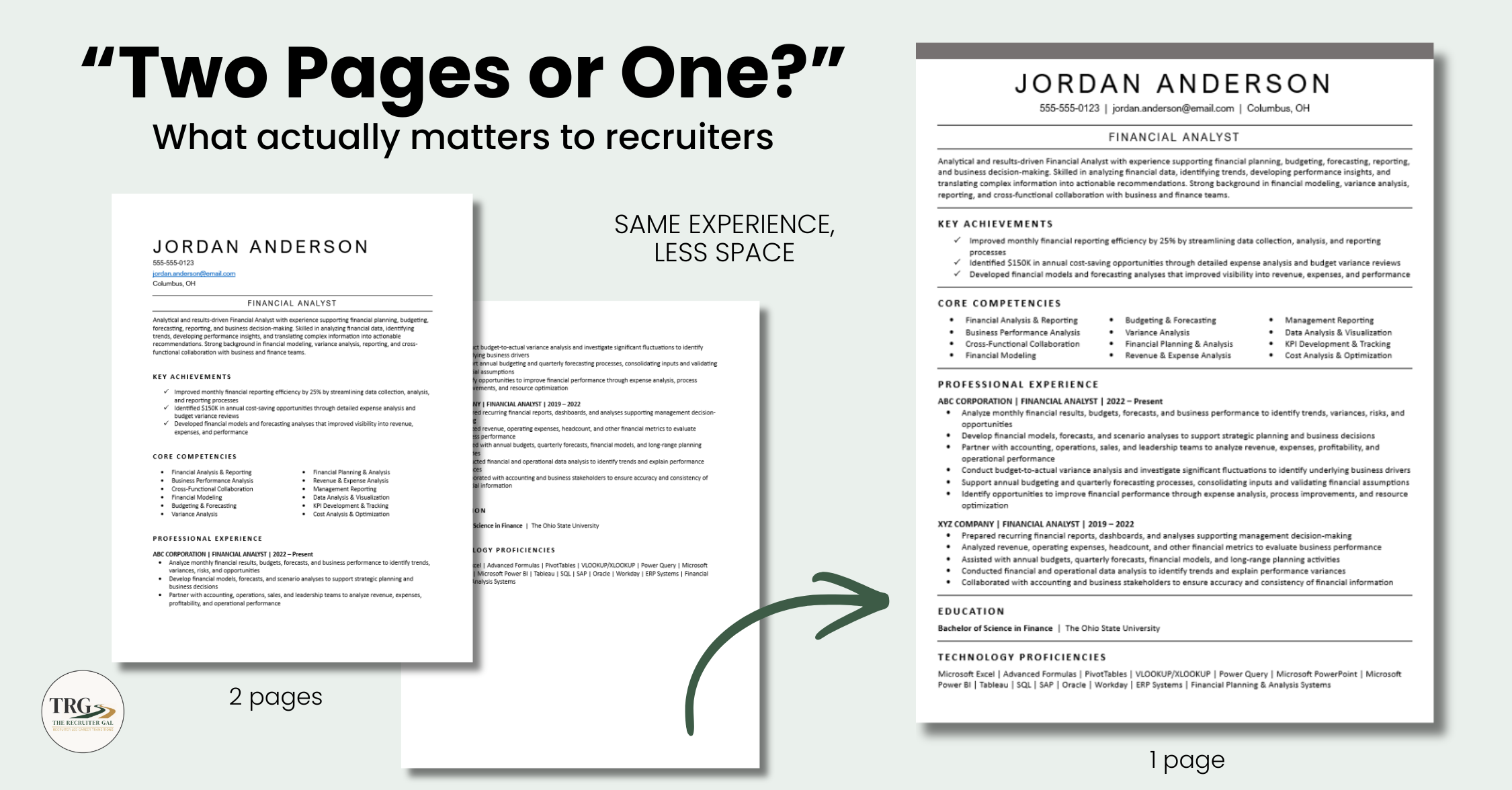
If you’ve ever searched for advice about how long your resume should be, you’ve probably come across the so-called “one-page rule.”
But does your resume really have to be one page?
Not necessarily.
Ideally, your resume should be one page if you can effectively communicate your experience, skills, education, and accomplishments in that amount of space. But if you have 10, 15, or more years of relevant experience, there’s absolutely nothing wrong with a two-page resume.
What I don’t recommend, in most situations, is going beyond two pages.
As a recruiter, I’m much less concerned about whether your resume is one page or two than I am about whether the information on those pages shows me that you’re qualified for the job.
So, How Long Should a Resume Be?
Here’s the general guideline I recommend:
- One page: Ideal for anyone really. Students, recent graduates, seasoned professionals, or anyone who can effectively summarize their relevant experience on one page.
- Two pages: Completely appropriate for experienced professionals, particularly those with 10–15+ years of relevant experience.
- Three or more pages: Occasionally justified, but there should be a good reason.
There are exceptions to every rule. But for the overwhelming majority of job seekers, your resume should not need to exceed two pages.
Even if you’re a CEO with 40 years of experience, you don’t need to tell me everything you’ve done during those 40 years. Your resume should highlight the experiences and accomplishments that best demonstrate the value you could bring to your next employer.
That’s an important distinction: a resume is a summary of your professional history. It is not a record of everything you’ve ever done at work.
How Far Back Should Your Resume Go?
You may have heard that your resume should only include the last 10 years of your work history. I don’t agree with that as a blanket rule.
There is no magic cutoff where experience suddenly stops being valuable because it happened 11 years ago.
The better question is: Is the experience still relevant?
If you have experience from 15 years ago that’s directly related to the position you’re applying for, it may absolutely deserve a place on your resume. On the other hand, an unrelated position from 15 or 20 years ago may add very little value and can often be left off.
You also don’t have to give every position the same amount of space. Your most recent and relevant roles should generally receive the most detail. Older experience can often be condensed to the company, title, dates, and perhaps a brief description or a few key accomplishments.
The goal isn’t to document every year of your career. It’s to show the experience that helps tell the story of why you’re qualified for the job you’re pursuing.
So rather than automatically cutting everything beyond 10 years, let relevance, not an arbitrary number, determine what stays on your resume.
A Resume Is Not the Same Thing as a CV
It’s also important to distinguish a traditional resume from a curriculum vitae, or CV.
A resume is a concise summary of your professional experience, skills, accomplishments, and education. A CV can be much more comprehensive and may include research, publications, presentations, teaching experience, awards, academic appointments, and other scholarly work.
That’s why advice about keeping a resume to one or two pages doesn’t necessarily apply to a CV.
Academic resumes can also present a unique situation. Someone working in academia may have extensive publications, research participation, conference presentations, and other relevant scholarly accomplishments.
That doesn’t necessarily mean all of that information needs to occupy several pages of the primary resume.
Depending on the position and application requirements, a detailed publication, presentation, research, or project list can sometimes be included as an addendum or accompanying document. This allows the primary resume to remain focused while still giving the employer access to the additional information when it’s relevant.
Always pay attention to the employer’s application instructions, particularly for academic, research, government, and other specialized positions where a CV or specific application format may be requested.
Can a Resume Be Three Pages?
Yes. But there should be a reason.
If your resume is three pages because you have highly specialized experience and the information is directly relevant to the position you’re pursuing, that’s very different from having a three-page resume because you’ve included every responsibility from every job you’ve ever held.
Before adding a third page, ask yourself:
Does the information on this page help demonstrate why I’m qualified for this particular job?
If the answer is no, it probably doesn’t need to be there.
I’ve seen resumes that are five, six, even eight pages long because the candidate listed virtually every responsibility they performed in every position they’ve ever held.
That’s not necessary.
A recruiter doesn’t need a complete inventory of everything you’ve done throughout your career. We need enough information to understand what you’ve accomplished, what skills you bring to the table, and how your background relates to the position we’re trying to fill.
What Recruiters Care About More Than Resume Length
Here’s what matters far more to me than whether your resume ends at the bottom of page one or continues onto page two:
Is your experience relevant to the job?
If I’m recruiting for a position and your background closely matches what we’re looking for, I’m not going to dismiss you because your resume is two pages instead of one.
I’m looking for evidence that you have the skills, experience, and accomplishments needed to perform the job.
That means relevance matters more than length. Your resume should make it easy for the person reading it to answer questions like:
- What does this person do?
- What are they particularly good at?
- What have they accomplished?
- Do they have the experience we’re looking for?
- Does it make sense to have a conversation with them?
If your resume answers those questions clearly, you’re accomplishing what the document is supposed to do.
Why Some Resumes Become Too Long
Usually, the problem isn’t that someone has “too much experience.” The problem is that the resume contains too much information.
One of the biggest culprits is listing too many job duties.
Let’s say you’ve held similar positions at three different companies. You probably performed many of the same core responsibilities in each job. You don’t need to repeat essentially the same list three times.
Instead, focus on what distinguished each position. What did you accomplish? What changed because of your work? Did you take on greater responsibility? Lead a team? Improve a process? Save money? Increase revenue? Complete a major initiative?
Those details tell me much more than another list of routine responsibilities.
How to Shorten a Resume That’s Too Long
If your resume is creeping into three, four, or more pages, you don’t necessarily need to start deleting valuable experience. First, look at how you’re using the space you already have.
1. Cut repetitive job duties
If you’ve performed similar work in multiple positions, you don’t need to describe the same responsibility in detail under every employer. Use that space to highlight accomplishments, increased responsibility, or experiences that differentiate one role from another.
2. Keep your professional summary short
Your professional summary should introduce your experience and value quickly. It shouldn’t take up half of the first page. In most cases, four or five lines is plenty. Think of the summary as an introduction to the resume, not the resume itself.
3. Look at your spacing
White space is important. A resume that’s packed from margin to margin with tiny text is difficult to read. But there’s also such a thing as too much white space.
Large gaps between sections, excessive paragraph spacing, oversized margins, and unnecessary blank areas can turn what should be a two-page resume into three pages.
The goal is balance: enough white space to make the document easy to scan without wasting valuable space.
4. Don’t let your header take over the page
Your name should stand out, and your contact information should be easy to find. It doesn’t need to consume the top quarter of the page.
If you’re early in your career and your resume looks unusually empty, using a slightly larger header or more generous spacing can help balance the page visually. But an oversized header shouldn’t be the reason an experienced professional’s resume spills onto another page.
5. Don’t document every project you’ve ever completed
I see this particularly with project managers. A project manager may have worked on dozens of significant projects throughout their career. Sometimes their resume includes every project, its scope, financial responsibility, timeline, deliverables, and outcome.
Suddenly, the resume is five pages long.
Instead, select a few projects that best demonstrate the scope and complexity of your experience and the results you’ve achieved. If a comprehensive project list is genuinely valuable for the positions you’re targeting, consider creating a separate project addendum or portfolio to accompany your resume when appropriate.
Your resume can highlight the best examples. The additional document can provide the complete picture.
The Bottom Line: Your Resume Should Be as Long as It Needs to Be, But No Longer
There isn’t a recruiter sitting somewhere with a red pen ready to reject every resume that crosses onto a second page.
One page is great when one page is enough. Two pages are perfectly appropriate when your experience warrants them. Three pages can occasionally make sense, but there should be a compelling reason.
And five, six, seven, or eight pages? In almost every traditional resume situation, that’s a sign that it’s time to start editing.
Remember what your resume is supposed to do. It isn’t your autobiography. It isn’t a list of every task you’ve performed, every project you’ve touched, or every responsibility you’ve ever been assigned.
It’s a marketing document designed to communicate the experience, skills, and accomplishments that make you relevant to the job you’re pursuing.
And sometimes the hardest part is figuring out exactly what belongs on those one or two pages.
Sometimes it’s hard to look at your own experience objectively and decide what deserves space on the page. If you’re not sure what to keep, what to cut, or how to bring it all together, I’d be happy to help.