
“How far back should my resume go?”
It’s a question I hear all the time, and there’s one piece of resume advice floating around that I strongly disagree with:
Your resume should only go back 10 years – I don’t believe in that rule.
If you have relevant experience from more than 10 years ago, leaving it off your resume entirely could mean leaving out information that matters, not only when an employer is evaluating your qualifications, but potentially when they’re determining your compensation offer.
Your Years of Experience Can Affect Your Salary
Something job seekers don’t always realize is that your salary offer may be influenced by the number of years of relevant experience you bring to the position.
Employers have to consider things like salary ranges and internal equity. Depending on the organization, they may look at your education, your years of relevant experience, and how your background compares with others doing similar work when determining an appropriate offer.
So, if you have 18 years of relevant experience but your resume only shows the most recent 10 because someone told you that was the “rule,” you may not be giving the employer the complete picture.
That’s why my advice is simple: Include all of your experience that is relevant to the position you’re applying for. The keyword there is relevant.
That Doesn’t Mean Every Job Gets Equal Space
Including an older position doesn’t mean you need to devote half a page to a job you held 15 or 20 years ago.
Your resume should still prioritize your most recent and most relevant experience.
If you’re currently doing work that’s directly related to the position you’re pursuing, that’s where I want to see the details. Tell me about your achievements, results, scope of responsibilities, and the things you’ve done that demonstrate why you’re qualified for this next position.
A relevant job from 15 years ago can look very different. You might include the company, title, dates, and one or two bullet points that capture the most important information. In some cases, simply listing the position may be enough.
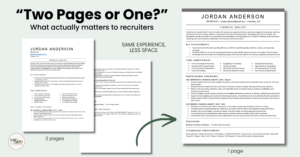
The point isn’t to give every position the same amount of space. The point is to make sure the employer can see the full scope of your relevant experience.
That’s also one of the things I consider when I write resumes for my clients at The Recruiter Gal. A strong resume isn’t just about making everything fit. It’s about deciding what deserves more space, what can be condensed, and what needs to be included so an employer sees the experience that matters.
Think Relevant, Not Just Recent
This is where I think the arbitrary 10-year rule falls apart.
Imagine you’ve been working for 20 years. Your first 8 years were spent doing work directly related to the position you’re applying for today. Your career then evolved, and your more recent roles have included broader responsibilities.
Why would we automatically erase those first eight years? They happened. They’re relevant. And they contribute to the experience you’re bringing to the table.
At the same time, if you had a job 18 years ago that has absolutely nothing to do with where you are today or where you’re trying to go, we probably don’t need to use valuable resume space listing it.
That’s why I don’t think the right question is simply: “How old is this experience?”
A better question is: “Does this experience help an employer understand why I’m qualified for this position?”
If the answer is yes, there’s probably a reason to include it.
Don’t Forget Your Education
The same idea applies to your education.
Include the education you’ve completed, particularly when it’s relevant to the role or could be considered as part of the employer’s qualification or compensation process.
Your resume is supposed to give the person reviewing it an accurate picture of what you’re bringing to the organization. Your professional experience is a major part of that picture, but your education and credentials can matter too.
So, How Far Back Should Your Resume Go?
There isn’t one number that works for everyone. I don’t recommend cutting your resume off at 10 years simply because you’ve been told resumes aren’t supposed to go back any further.
Instead, include the experience that’s relevant to the job you’re pursuing, regardless of whether it happened 5, 10, 15, or even more years ago. Then be strategic about how much space you give it.
Recent and highly relevant experience should get the most attention. Older relevant experience can be condensed. Older experience that has no bearing on the position you’re pursuing may not need to be there at all.
Your resume doesn’t need to document every single thing you’ve done throughout your career.
But it should tell the complete story of the experience that matters.
And sometimes, figuring out what belongs, what can go, and how much space to give 15 or 20+ years of experience is the hardest part.
If you’d rather not figure that out on your own, that’s where I come in.
At The Recruiter Gal, I write resumes from the perspective of someone who has spent 21 years on the hiring side of the table. We’ll make sure your resume reflects the depth of your experience without reading like a career history book.
Ready for help with your resume?